

From Nathanael Greene Society Member, hazard’s ghost
From Tucker Carlson interviews to reformed Christian personalities on X, no discussion of modern liberalism is complete without a revisionist analysis of the Second World War. Pundits and parishioners alike are abuzz talking about the effects of the “Postwar Consensus” (PWC). Most who use the term PWC define it as a set of leftist presuppositions that undergird all public discourse in the West and have resulted in disastrous policy in Western Nations. Broadly, these presuppositions are: 1. The inherent immorality of nationalism and the inherent goodness of multiculturalism. 2. The moral necessity of radical equity of outcomes amongst all individuals regardless of race, sex, culture, sexual orientation or religion.
Many PWC critics argue that the Western response to the World Wars resulted in the policies and beliefs that make up the PWC. However, their insistence on anchoring that argument to World War II revisionism undermines an otherwise needed critique. The term “postwar” is only helpful in describing when the various elements and policies of the PWC coalesced in the West, not in describing the cause. The ideas, movements and policies of the PWC, had their nexus well before, and happened in near total isolation to World War 2. By arguing that the World War 2 caused the PWC, these revisionists anchor their critiques to a shaky historical foundation and surrender the powerful moral iconography the World Wars represent. Both of which hurt our cause tremendously.
In his September 2024 interview with Tucker Carlson, Darryl Cooper argued that in the aftermath of World War 2, the Allies’ zeal to ensure fascism never took root again was the source of antinationalist fervor. The Allies concluded that strong national attachments and ethnic identity had to be dissolved in order to prevent the rise of another Hitler. Cooper even claimed that Churchill was the “chief villain of World War 2” arguing that the British Prime Minister was “primarily responsible for the war becoming what it did.”
However, neither claim has much basis in reality. Leftist disillusionment with nationalism has its roots in the US and Great Britain going back to the late 19th century. Public opinion of colonialism in England turned sharply critical during the Second Boer War. Socialists in the United Kingdom fueled criticism of nationalism with exaggerated tales of imperial greed and concentration camps mistreating Boer women and children. This criticism turned into full blown disillusionment in Britain after World War 1. Screeds such as All Quiet on the Western Front (1928) and For Whom the Bell Tolls (1940) emphasized a profound cynicism for patriotism and national spirit. World War 1 also spurred efforts like Woodrow Wilson’s League of Nations and other globalist nonsense.
Likewise in the United States, there was growing humanitarian outrage from leftists over US policy towards American Indians. Leftists such as Helen Hunt Jackson harshly criticized the spirit of “Manifest Destiny” that had defined the United States only a generation prior. There were other small, but vocal opposition movements to US involvement in the Spanish American War and the Philippines (Jackson, 1881). While the current iteration of anti-nativist sentiment in the US and Britain accelerated in the aftermath of the Second World War, it got its start nearly a century before.
Moving on to World War 2, Churchill certainly made numerous foreign policy blunders in the lead up to the war. From advocating for harsh, punitive terms at the treaty of Versailles, to the Anglo-German Naval Agreement of 1935, to his advocacy for declaring war on Germany after the invasion of Poland, Churchill (and Britain as a whole) often allowed his temper to color his policy. However, to argue that he was “the chief villain of WW2” is to ignore the numerous diplomatic off ramps both Kaiser Wilhelm and Hitler had during their respective wars. No one forced Germany to invade Belgium (either time) or Poland unprovoked. The Kaiser could have reneged on his treaty with Austria-Hungary likely forcing them to avoid war with Russia. Moreover, the Kaiser’s statesmanship (or lack thereof) is largely responsible for the web of treaties that led to WW1 in the first place (Röhl, 2014).
After Britain and France did nothing when Germany remilitarized the Rhine in March of 1936, Hitler could have capitalized on this diplomatic victory by seeking formal recognition of German equality (Buchanan, 2008). Hitler could have honored the Munich Agreement of 1938. Following the occupation of Czechoslovakia in 1939, Hitler refused peace talks with Britain and France which were intended to resolve disputes over Danzig and the Polish Corridor. Instead, Hitler signed the Molotov-Ribbentrop pact which handed over half of Christian Poland to the Communist Bolsheviks of the USSR. This was done ostensibly to gain the winter port of Danzig for Germany’s fledgling Atlantic surface fleet. This fleet, however, was wholly incapable of challenging Great Britain, much less the United States, anyway (Bouverie, 2019). Certainly Churchill, and the Allies more broadly, misread the diplomatic situation of the 1930s. But to frame Hitler as simply misunderstood and reactive is to ignore the fact that he consistently chose aggressive actions when alternatives existed.
Feminism and radical racial justice movements also began long before, and in isolation to the World Wars. Harriet Beecher Stowe wrote the famous Uncle Tom’s Cabin in 1852 accelerating abolitionist sentiment in the US. Her sister, Isabella Beecher Hooker worked closely with Susan B Anthony in founding the National Women’s Suffrage Association in 1869. Even before this, the Grimké sisters, Angelina and Sarah, toured as abolitionist lecturers in 1837, arguing for women’s right to participate in public discourse, which laid groundwork for feminist demands (Hershberger, 1999). By 1838, Kentucky allowed some women (female heads of household in rural areas) to vote in school elections, marking an early feminist milestone. The 1840 World Anti-Slavery Convention in London excluded women delegates like Lucretia Mott, inspiring her and Elizabeth Cady Stanton to organize the 1848 Seneca Falls Convention, where 300 attendees signed the Declaration of Sentiments calling for women’s equality, including suffrage (Rendall, 1985).
The NAACP was founded in 1909 to advance the cause of radical racial equity through legal challenges. Meanwhile, the feminist movement splintered: In 1869, Stanton and Anthony founded the National Woman Suffrage Association (NWSA), focusing on federal amendments, while Lucy Stone led the American Woman Suffrage Association (AWSA), emphasizing state-level wins. They merged in 1890 into the National American Woman Suffrage Association (NAWSA). Intersections persisted through figures like Ida B. Wells, who in 1892 co-founded the National Association of Colored Women in 1896 to address both racial and gender issues (Hershberger, 1999). These movements that birthed modern Second and Third Wave feminism and social justice movements found their genesis long before, and in complete isolation to, the World Wars.
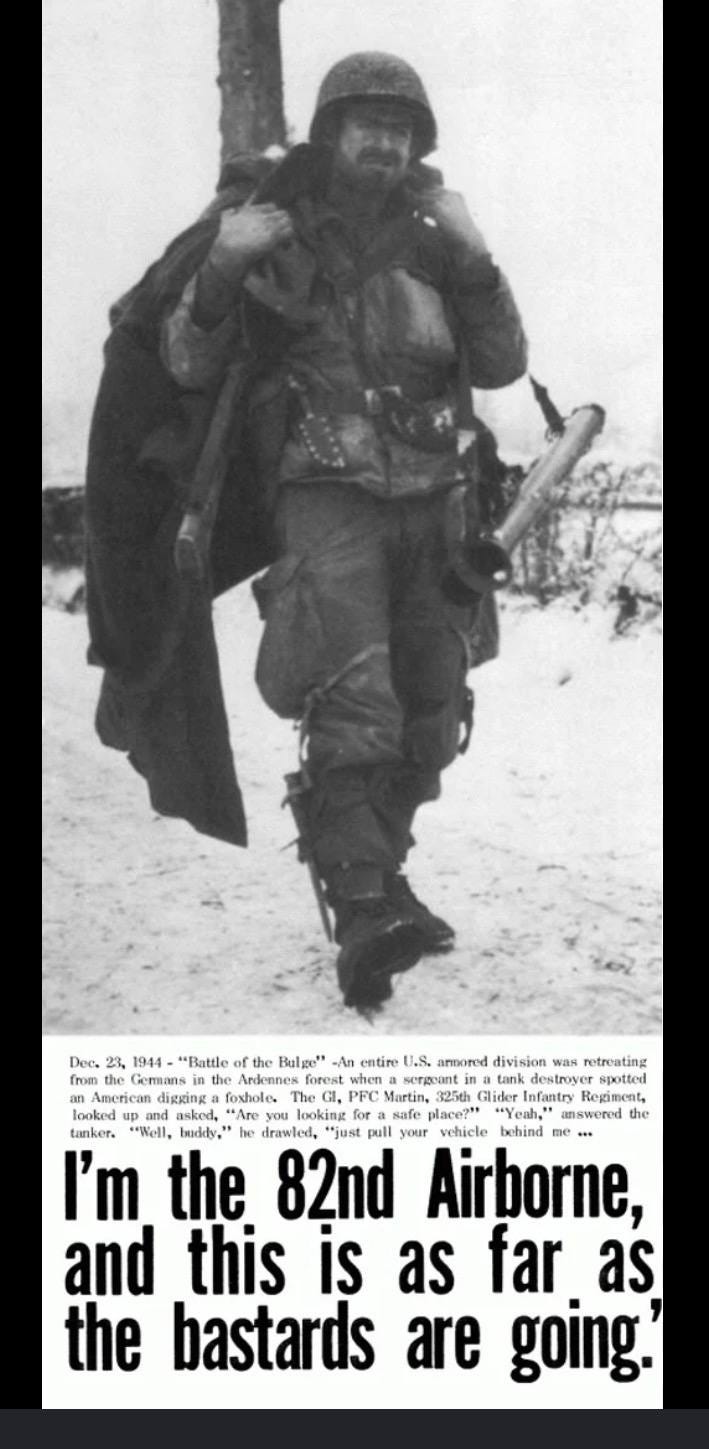
The historicity (or lack thereof) of World War 2 Revisionism aside, the iconography of the war remains powerful in the moral imagination of Americans. When you look at a picture of Old Glory being raised over Iwo Jima, or Eisenhower talking to the 101st Airborne before D-Day it inspires radical Patriotism in the hearts of most Americans. Patriotism is inescapably right-wing. This is a good thing. The imagery of World War 2- imagery that highlights American heroes triumphing over our enemies- is exactly the aesthetic choice that captures the hearts of American men. The left used and abused the term “Nazi” as a political epithet because it was effective. Mapping your political enemies onto the enemies of the United States more broadly is one of the most effective propaganda mechanisms at our disposal. To surrender this imagery to the Left is a colossal error. Even if you buy wholesale into the proposition that the Axis Powers were “the good guys” tactically, you must admit that it’s a tall order to get a majority of Americans to believe that the men who bombed Pearl Harbor were good, and the men who raised Old Glory over Iwo were evil. Most American men, especially white American men, will not identify with Heinz Guderian over PFC Martin holding a bazooka and sporting a self-assured smirk on his face, quipping “I’m the 82nd Airborne, and this is as far as the bastards are going.” The narrative of World War 2 is one of masculine, white, Christian, American men saving Western Civilization through their heroism and unshakeable patriotism. Even if the narrative is sugarcoated, rejecting its powerful moral framing is a tactical error. To do so, is to follow the path of leftist revolutionaries who tear down statues of Jefferson, Lee, and Jackson.
In conclusion, World War 2 Revisionism is both ahistorical and a tactically unsound rhetorical device. The historic errors of World War 2 Revisionism lend credence to otherwise unreasonable rebuttals of PWC critiques. We live in a cultural moment where harnessing the political energy of young men to the political apparatus of older right-wing boomers is perhaps the most important political goal. Not acknowledging the grave errors of PWC policy is a sure way to lose young men. But World War 2 revisionism is a sure way to alienate the boomer apparatus. Giving up the positive moral imagery of the World Wars is a good way to estrange both boomers and normal American young men alike. A third way exists where we acknowledge the ills of the PWC while simultaneously recognizing that the “postwar” is just a reference to time and not cause.
References:
Buchanan, P. J. (2008). *Churchill, Hitler, and the Unnecessary War: How Britain lost its Empire and the West lost the World*. Crown.
Jackson, H. H. (1881). A century of dishonor: A sketch of the United States government’s dealings with some of the Indian tribes. Harper & Brothers. (Reprinted editions are also commonly cited, e.g., University of Oklahoma Press versions.)
Hershberger, M. (1999). Mobilizing women, anticipating abolition: The struggle against Indian removal in the 1830s. The Journal of American History, 86(1), 15–40. https://doi.org/10.2307/2567405
Röhl, J. C. G. (2014). Wilhelm II: Into the abyss of war and exile, 1900–1941. Cambridge University Press.
Bouverie, T. (2019). Appeasement: Chamberlain, Hitler, Churchill, and the road to war. Tim Duggan Books.
Rendall, J. (1985). The origins of modern feminism: Women in Britain, France and the United States, 1780–1860. Macmillan (or Schocken Books).
This is a needed counter position to the prevailing historiography on the Right. However, you've approached it from the wrong angle. At issue in the World Wars was not social conservatism or agitation (both sides were predominantly socially conservative), but the legitimacy of political violence as a means of national and international politics.
The Germans and Italians obtained statehood later than the other European great powers and attempted to advance their position (otherwise strategically hopeless) by military means. Similarly, the nationalist right of those countries did the same versus weak establishments. By contrast, the geopolitical and political situations in France, Britain, and America were strong and stable. Furthermore, these nations understood the settlement after the defeat of Napoleon to still be in force, and did not feel that they should have to make more room at the table.
Now one can claim that England was hypocritical for declaring German violence anathema while exercising its own, but you cannot claim that England was wrong and Germany was right. If Germany was correct to pursue its goals with maximum violence than England surely had the right to respond in kind. Meanwhile from an American point of view, we both gained the most benefit from the war and didn't start it. To blame Americans, one must almost construct a moral framework where it is villainous to win.
Thank you for writing about this! This is a critically important topic that has massive implications, far more than most people realize. And I think you hit the nail on the head. Forgive the shameless self plug, but I have also written about this exact topic ( it was sort of one of the main reasons I even made this Substack). If you're interested, here's an article I did on this topic.
https://handlebarhistorian93.substack.com/p/historic-reality-the-current-rewrite?utm_source=share&utm_medium=android&r=74rsan